Showing posts with label Health. Show all posts

New meningitis test 'could save lives'

August 31, 2017

A hospital A&E department in Northern Ireland is to start using a new, rapid test for meningitis that should speed up diagnosis and save lives.
Meningitis can kill in hours yet the current way to positively identify the infection takes about two days.
UK researchers say the new test that the Royal Belfast Hospital for Sick Children will use gives results in under 60 minutes.
This should let doctors treat fast and accurately, rather than "just in case".
Speedy treatment is vital because the infection can quickly overwhelm the body, and symptoms may not be obvious until it is dangerously advanced.
At the moment, doctors rely on clinical judgement to decide whether antibiotics are urgently needed.
They err on the side of caution, which means some patients are given treatment they don't need.
However, on rare occasions cases can be missed, which is where a rapid "Lamp" (Loop Mediated Isothermal Amplification) test on blood, spinal fluid or nasal swab samples could help.
Anyone can get meningitis, but it is more common in babies, children and teenagers or young adults.

Amy's story

Amy Davis was 18 when she became severely ill with meningitis. Initially, she thought she just had a simple case of flu.
Hours later, her body was covered head-to-toe in the alarming blotchy purple rash which is a classic - although not always present - sign of meningitis.
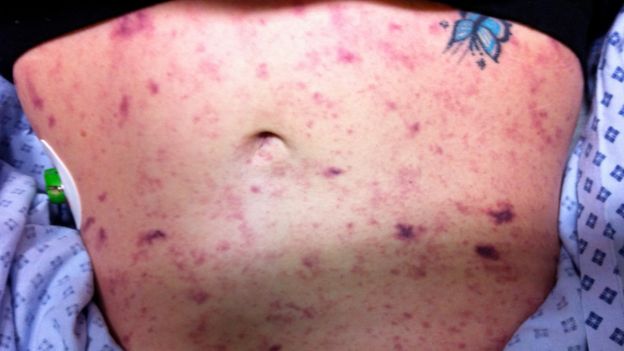
Amy Davis' stomach
Amy, now 25, recalls: "My mum, being an ex-nurse, knew what it was straightaway and called an ambulance.
"It was really scary. I remember looking at my dad and he looked absolutely terrified so I knew something was seriously wrong."
Amy developed a serious complication called septicaemia or blood poisoning. The damage that this caused meant she needed her left leg amputated below the knee.

Meningitis facts

  • Meningitis is an infection of the protective membranes surrounding the brain and spinal cord and caused by a number of different pathogens
  • Viral meningitis is the most common and least serious type. Bacterial meningitis is rare but can be very serious if not treated
  • If you are worried that someone is seriously ill with meningitis, trust your instincts and seek urgent medical help. Don't wait for a "tell-tale" rash
  • There are vaccines that can protect against some forms of meningitis

Treating potential bacterial cases with antibiotics is still the safest approach and doctors at the Royal Belfast Hospital will continue to do this during the two-year pilot.
But they will also use the rapid Lamp test to quickly see if their clinical hunches are right.
Researcher Dr Tom Waterfield from Queen's University, Belfast, said it could also spot less obvious cases that might otherwise slip through the net.
"With the best will in the world you can still miss cases if a child looks quite well and you think it is viral rather than bacterial.
"The test could also provide reassurance earlier to anxious parents that their sick child is getting the right treatment. Two days is a long time to wait for a confirmed diagnosis."
Rob Dawson, from the Meningitis Research Foundation, said a simple, rapid diagnostic was long overdue.
"There is an urgent need for developments in this area and we look forward to seeing how this test could work in a hospital or healthcare settings."
The work is funded by the Health and Social Care NI Public Health Agency and by the Royal College of Emergency Medicine and is being done in collaboration with Queen's University Belfast, the Paediatric Emergency Research UK & Ireland Network and The Belfast Trust.
Private company Hibergene have patented the Lamp testing equipment that is on loan to the hospital for the study.

Kent Heckenlively, US 'anti-vaxxer', denied Australian visa

August 31, 2017
A US author who bills himself as the "world's #1 anti-vaxxer" has been denied a visa to enter Australia for a speaking tour.
Kent Heckenlively had planned to visit Australia in December to call for a five-year ban on vaccinations.
Medical experts, including the World Health Organization, have repeatedly said that vaccinations are safe and vital to halting infectious diseases.
Australia gave bans to two other anti-vaccination advocates last month.
Immigration Minister Peter Dutton confirmed that Mr Heckenlively would not be allowed to enter Australia, describing anti-vaccination advocates as "dangerous people".
"It is clear to me that it is not in our national interest that he should come here," Mr Dutton told local radio station 2GB.
Last month, British anti-vaccination campaigner Polly Tommey and Suzanne Humphreys from the US were banned from entering Australia for three years.
They had claimed a link between a vaccine and autism, an idea which has been overwhelmingly discredited by science.
Vaccines can cause adverse reactions in a small number of people, like many medicines, but the accepted science is that the benefits far outweigh the risks.
Widespread vaccination also reduces the risk of infection to those who, for medical reasons, may not be able to receive the vaccine themselves.
Earlier this year, Australia it would consider a childcare ban - dubbed a "no jab, no play" law - on children who had not been vaccinated.

Anti-inflammatory drug 'cuts heart attack risk'

August 31, 2017

Anti-inflammatory drugs could cut the risk of heart attacks and strokes, a study of 10,000 patients suggests.
A trial of the drug canakinumab could represent the biggest breakthrough in treatment since the advent of statins to lower cholesterol, its authors say.
The study reported a 15% reduction in the risk of a repeat heart attack among patients - but others questioned the drug's efficacy, side-effects and cost.
Recipients of the drug had an increased risk of potentially fatal infections.
However, the British Heart Foundation (BHF) said the "exciting and long-awaited trial" could still help save lives.

Arthritis drug

Heart attack patients are routinely given cholesterol-lowering statins and blood-thinning drugs to help reduce the risk of repeat attacks.
In this study, 10,000 patients who had previously had a heart attack were treated with the anti-inflammatory drug once every three months.
The trial, held in almost 40 countries, monitored the individuals for up to four years.
It found what researchers said were reductions in risk "above and beyond" those seen in patients who only took statins.
However, it also found a "significantly higher incidence" of potentially fatal infection and sepsis among those treated with the drug, according to the study.
The results were presented at the European Society of Cardiology meeting, held in Barcelona, Spain.
Canakinumab was initially developed by pharmaceutical firm Novartis - which paid for the trial - to treat rheumatoid arthritis.
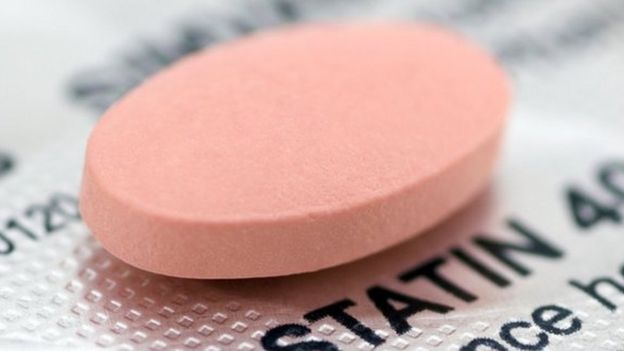
statin pill
A heart attack is a serious medical emergency in which the supply of blood to the heart is suddenly blocked.
Experts have previously spoken about its possible link with inflammation of certain blood vessels. However, authors say such a link has never been proven before in humans.
The study's lead author Dr Paul Ridker, of Brigham and Women's Hospital, part of Harvard Medical School, said the study represented "a milestone in a long journey".
"For the first time, we've been able to definitively show that lowering inflammation independent of cholesterol reduces cardiovascular risk," he said.
"This has far-reaching implications."
Dr Ridker continued: "In my lifetime, I've gotten to see three broad eras of preventative cardiology.
"In the first, we recognised the importance of diet, exercise and smoking cessation. In the second, we saw the tremendous value of lipid-lowering drugs such as statins. Now, we're cracking the door open on the third era. This is very exciting."
Dr Ridker said the findings also indicated "the possibility of slowing the progression of certain cancers", but further research was required.

'Safety trade-offs'

Dr Robert Harrington, chair of the Stanford University School of Medicine, sounded a note of caution in an editorial in the New England Journal of Medicine.
He said the effects of anti-inflammatories could be "modest", and the absolute clinical benefit of canakinumab "cannot justify" its routine use "until we understand more about the efficacy and safety trade-offs, and unless a price restructuring and formal cost-effectiveness evaluation supports it."
Others, though, say the treatment could help those at risk of repeat heart attacks for whom statins are not enough.
Prof Jeremy Pearson, associate medical director at the BHF, said: "The findings suggest that existing anti-inflammatory drugs, such as canakinumab, could be given along with cholesterol-lowering drugs to treat survivors and further reduce their risk of another heart attack."
Gary Gibbons, director of the National Heart, Lung, and Blood Institute, said the findings provided "compelling evidence".
He called for further research into the findings.

Cyber-flaw affects 745,000 pacemakers

August 31, 2017
A total of 745,000 pacemakers have been confirmed as having cyber-security issues that could let them be hacked.
The Food and Drug Administration revealed that 465,000 pacemakers in the US were affected, in an advisory note about a fix to the problem.
The pacemaker's manufacturer, Abbott, told the BBC there were a further 280,000 devices elsewhere.
The flaws could theoretically be used to cause the devices to pace too quickly or run down their batteries.
However, Abbott said it was not aware of any cases of this happening, adding that it would require a "highly complex set of circumstances".
The Department of Homeland Security has said that an attacker would need "high skill" to exploit the vulnerabilities.

Three-minute fix

The affected pacemakers are branded as having been made by St Jude Medical, which was acquired by Abbott earlier this year.
Patients are being advised to ask their doctors about an available firmware update at their next scheduled appointment.
The pacemakers can receive the revised code by being placed close to a radio wave-emitting wand in a process that lasts about three minutes.

Pacemakers manufactured after 28 August will come with the new firmware pre-installed.
"As with any firmware update, there is a very low risk of an update malfunction," the FDA said.
The regulator noted a very small number of St Jude devices had lost all functionality after a firmware update in the past.
Abbott said some patients might opt to continue with the old firmware as a consequence.
"In some cases, doctors and patients will decide that the risks that could be associated with performing the new pacemaker firmware update for some patients may outweigh the benefits," it said in a note to pacemaker users.
"If you do not receive the update, your pacemaker will continue to function as intended, and you can receive the update at any future time."

Legal battle

The benefit of allowing the pacemakers to send and receive data wirelessly is that patients can pair them with a transmitter at home that monitors the devices as they sleep and can potentially alert them to medical problems.
Merlin@home system
A hedge fund, Muddy Waters Research, first warned the media in August 2016that the cardiac equipment had security flaws and claimed they could be exploited by "low-level hackers".
The investment company also revealed it had bet St Jude's shares would drop after it had been told of the issues by security company MedSec.
"[St Jude's] apparent lack of device security is egregious, and in our view, likely a product of years of neglect," Muddy Waters said at the time.
St Jude responded by saying it stood behind the security and safety of its equipment and sued its accuser for defamation.
However, shortly after Abbott bought St Jude in January, the FDA confirmed there were vulnerabilities in the company's wireless home monitor system, which were subsequently addressed.
Then, in April, the watchdog said Abbott had failed to properly investigate wider cyber-security concerns.
Even so, the medical company's legal action against Muddy Waters continues.

First cancer 'living drug' gets go-ahead

August 31, 2017
The US has approved the first treatment to redesign a patient's own immune system so it attacks cancer.
The regulator - the US Food and Drug Administration - said its decision was a "historic" moment and medicine was now "entering a new frontier".
The company Novartis is charging $475,000 (£367,000) for the "living drug" therapy, which leaves 83% of people free of a type of blood cancer.
Doctors in the UK said the announcement was an exciting step forward.
The living drug is tailor-made to each patient, unlike conventional therapies such as surgery or chemotherapy.
It is called CAR-T and is made by extracting white blood cells from the patient's blood.
The cells are then genetically reprogrammed to seek out and kill cancer.
The cancer-killers are then put back inside the patient and once they find their target they multiply.

'Enormously exciting'

Dr Scott Gottlieb, from the FDA, said: "We're entering a new frontier in medical innovation with the ability to reprogram a patient's own cells to attack a deadly cancer.
"New technologies such as gene and cell therapies hold out the potential to transform medicine and create an inflection point in our ability to treat and even cure many intractable illnesses."
The therapy, which will be marketed as Kymriah, works against acute lymphoblastic leukaemia.
Most patients respond to normal therapy and Kymriah has been approved for when those treatments fail.
Dr Stephan Grupp, who treated the first child with CAR-T at the Children's Hospital of Philadelphia, said the new approach was "enormously exciting".
"We've never seen anything like this before," he added.
That first patient had been near to death, but has now been cancer-free for more than five years.
Out of 63 patients treated with CAR-T therapy, 83% were in complete remission within three months and long-term data is still being collected.
However, the therapy is not without risks.
It can cause potentially life-threatening cytokine release syndrome from the rapid proliferation of the CAR-T cells in the body. This can be controlled with drugs.

New era

But the potential of CAR-T technology goes beyond one type of cancer.
Dr David Maloney, medical director of cellular immunotherapy at the Fred Hutchinson Cancer Research Center, said the FDA's decision was a "milestone".
He added: "We believe this is just the first of what will soon be many new immunotherapy-based treatments for a variety of cancers.
CAR-T technology has shown most promise against different blood-based cancers.
However, it has struggled against "solid tumours" such as lung cancer or melanoma.
Dr Prakash Satwani, a paediatric oncologist at Columbia University Medical, said: "The results haven't been that great when you compare it with acute lymphoblastic leukaemia, but I'm sure the technology will get better in the near future."
Boosting the immune system is already a cornerstone of modern cancer treatment.
A range of drugs that "take the brakes off" the immune system to allow it to attack cancer more freely have already been adopted around the world.
CAR-T technology, which goes a step further and redesigns the immune system, is at a much earlier stage.
Prof Peter Johnson, the chief clinician at the charity Cancer Research UK, said: "The first genetically modified cell therapy to be approved by the FDA is an exciting step forward.
"We still have a lot to learn about how to use it safely and who might benefit from it, so it is important to recognise this is just a first step."

Trial raises Parkinson's therapy hope

August 31, 2017
Scientists have restored nerve cells destroyed by a condition similar to Parkinson's disease, in monkeys.
The Japanese team hope their work could lead to stem cell trials in human patients before the end of 2018.
Parkinson's disease causes the progressive loss of nerve cells that release dopamine, a chemical that helps control body movement.
The researchers triggered a similar loss of cells in macaque monkeys, then used human stem cells to replace them.
The animals showed significant improvement in their symptoms two years after having precursor dopamine neurons derived from human stem cells transplanted into their brains.
These cells - known as induced pluripotent stem (iPS) cells - are created by genetically reprogramming ordinary adult cells, so that they revert to an embryonic-like state.
In this state, they can then be coaxed to develop into many different adult cell types - in the case of this experiment, dopamine neurons.
Researcher Prof Jun Takahashi, from Kyoto University, said the work, published in the journal Nature, showed that the artificially created cells were as effective as those created naturally in the brain of the monkeys.
He said: "Because iPS cells are easy to obtain, we can standardise them to only use the best iPS cells for therapy."
Brain scans confirmed the cells were functioning as expected and not triggering a damaging immune response, or the growth of cancerous tumours, which can be associated with experimental stem cell therapies.
The researchers also found that the quality of the donor cells was the key factor - not how many each monkey received.
Dr Tilo Kunath, a Parkinson's UK-funded researcher at the Medical Research Council Centre for Regenerative Medicine at the University of Edinburgh, said: "This is extremely promising research demonstrating that a safe and highly effective cell therapy for Parkinson's can be produced in the lab.
"Such a therapy has the potential to reverse the symptoms of Parkinson's in patients by restoring their dopamine-producing neurons.
"The next stage will be to test these therapies in a first-in-human clinical trial."
Prof Tom Foltynie, of the National Hospital for Neurology & Neurosurgery, said there would be concerns about how stem cell transplants might pan out in human Parkinson's patients, but the latest work had addressed some of the previous uncertainty about whether it was safe to use iPS cells.
He said "Overall, the results they report in the short term are encouraging and provide some reassurance that these cells can function as sources of dopamine to address those movement symptoms of Parkinson's disease that relate to dopamine loss.
"No-one expects that transplants will address the non-dopamine, non-movement aspects of Parkinson's disease such as dementia and falls, which ultimately emerge with very long-term follow up."